A Bridge Too Far.
Hull’s Scale Lane Footbridge raises an awkward question about civic landmarks. Who keeps counting the cost once everyone has gone home from the opening ceremony?

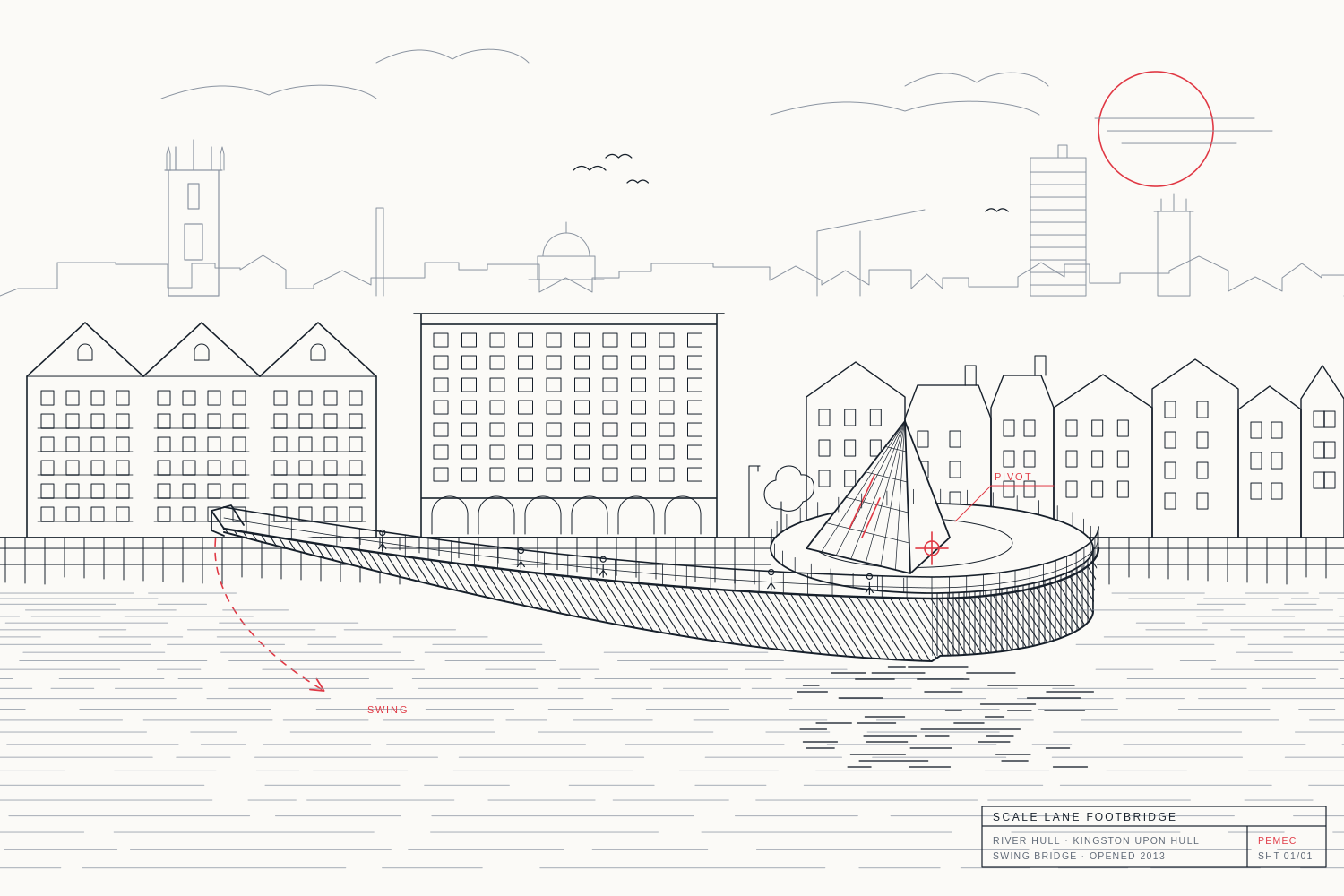
Britain has developed a peculiar relationship with public infrastructure. We love commissioning it, naming it, photographing it and entering it for awards. Keeping it working offers fewer opportunities to wear a hard hat in the local paper.
Consider Hull’s Scale Lane Footbridge.
Opened in 2013, it was conceived as a crossing, a destination and a catalyst for riverside regeneration. Its architect lists a £7 million budget. Visitors could stay aboard as it swung across the river, making the journey itself part of the attraction. It collected awards for architecture, engineering and community impact. This was a bridge with an unusually busy social calendar.
SourceBenedetti Architects, project description and budget · Archinect, project profile and opening date
There is something rather wonderful about that ambition. There is also a question which tends to become more expensive the longer you leave it.
How much does all this cleverness cost to keep working?
The crossing becomes a gap
In December 2024, Hull City Council announced that bearings in the swing mechanism needed replacing. The bridge would be swung open for river traffic and remain there pending repairs. For anyone approaching on foot, that meant the crossing had become a gap.
SourceHull City Council, December 2024 closure announcement
It reopened to pedestrians and cyclists on 6 March 2025, following investigations. Its movements remained restricted to essential river traffic and emergencies while the council planned further maintenance. A bridge sold partly on the experience of watching it move had acquired a rather more cautious relationship with movement.
SourceHull City Council, March 2025 reopening announcement
By May 2026, three wheels had been removed, examined and refurbished. Installing the third required another closure. Further investigations were still needed to determine permanent modifications to the remaining wheel assemblies.
SourceHull City Council, May 2026 engineering update
Then came a further closure scheduled for 3–18 November 2026. The council’s programme described fatigue failure in mechanical fixings identified in August 2024, replacement connection bolts and tests of the bridge’s balance and performance. That scheduled end date alone does not establish that the bridge reopened.
SourceHull City Council, Scale Lane maintenance programme · October 2026 closure announcement
Read those announcements together and you find yourself wondering whether Britain needs an additional architectural award. Best Explanation of Why the Award-Winning Thing Is Temporarily Unavailable.
Where the question sits
The engineers doing this work deserve credit. They are dealing with a specialised structure and keeping people safe. The political question sits further upstream, where ambition, procurement and maintenance budgets first meet.
A bespoke moving bridge creates obligations stretching decades beyond its launch. Someone must inspect it, obtain parts, secure specialist expertise and plan closures. Residents experience those obligations as journeys, diversions and occasional disappointment. The council experiences them as invoices.
Yet the public conversation remains remarkably attached to the opening price.
For Scale Lane, £7 million is the budget published by its architect. That figure alone cannot tell us what the bridge has cost over its working life, or whether it represents good value. The public records reviewed for this article did not establish a verified cumulative bill for the subsequent investigations and repairs.
SourceBenedetti Architects, published project budget
That missing total matters. Anyone asking residents to celebrate an investment should be equally willing to explain its continuing cost.
Hull’s council has approved a coordinated five-year maintenance programme covering bridges and other infrastructure. Its stated objectives include reducing emergency closures, improving safety and keeping the city connected. Those are precisely the outcomes against which residents should judge the spending.
SourceHull City Council, infrastructure maintenance programme
Put the lifetime bill on the lectern
This is where the vanity-project argument becomes serious.
A landmark earns its place through what people can do with it over time. Awards and visitor appeal can contribute value, but the crossing must also justify the cost of operating it. When promotional claims are easy to find and lifetime accounts require detective work, residents are entitled to become cynical.
They should be able to see the original business case, actual expenditure, annual maintenance costs, repair spending and usage figures together. How many journeys does it support? How often is it available? What has happened to the regeneration benefits used to justify it?
Those are ordinary questions for an asset bought with public money.
They also change how we judge the next proposal. A spectacular design may well deserve funding. Its maintenance plan deserves the same scrutiny as its architectural drawings, while there is still time to choose and money to budget.
Hull deserves ambition. It also deserves the confidence that comes from being able to walk across the thing.
Before the next civic landmark gets its ribbon, perhaps somebody should put the lifetime bill on the lectern.
Then we can all decide whether it is a bridge too far.